






Taking online classes may appear simple on the surface. There are no rush around taking online classes, you can study from home, lectures can be recorded, and you have a greater flexibility of choice in your timing. However, this flexibility also comes with some challenges, which are often related to time management and procrastination. Also, since there is no supervision and set timelines, sometimes students get into situations where they have only one choice at a time, either attending online classes or dealing with other commitments. Handling such situations in an academic career is one of the major challenges that severely affect students’ performance if they don’t have enough online learning skills to survive in online courses. These situations often leave students with no choice except seeking professional help services where they can ask, “Can I pay someone to take my online class?” to balance their academics with personal lives.
This is where students should understand why it takes more than just attending classes to succeed in an online course. You also need to know how to “manage” yourself, your time, your attention, and your digital environment. The following online learning skills can help make online learning a lot easier.
Quick Overview: Online learning skills such as time management, self-discipline, digital literacy, and organization help students succeed in online courses. By staying focused, managing deadlines, using digital tools effectively, and seeking support when needed, students can improve academic performance and achieve their learning goals.
What are the Top Skills to Survive in Online Courses?
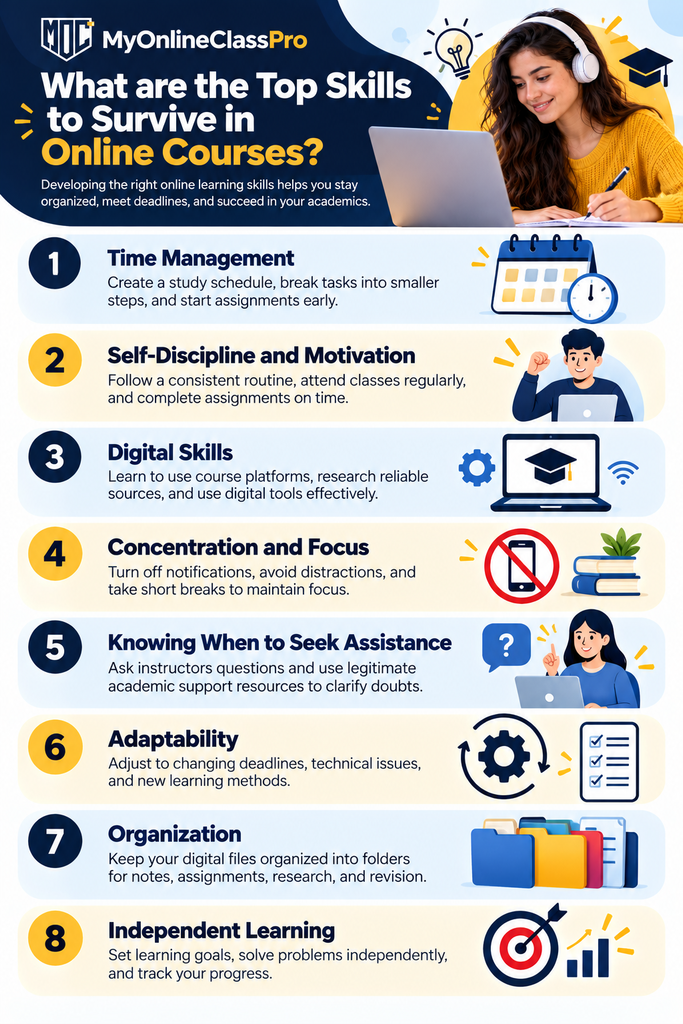
If you need to survive your online classes, you have to know the skills. Below are top skills that you can work on if you want to be successful in your academic journey.
Time Management
Probably one of the most important online learning skills for students is Time Management. In face-to-face classes, the tendency to put things off is easy to see, as there are plenty of extra hours to do so. In an online class, it can be easy to say, “That’s okay, I have plenty of time; I’ll catch up later.” Then suddenly, you have to deal with 3 assignments in one week.
For example, an accounting student may avoid approaching assignment deadlines, thinking he has enough time to complete until the last minute task is assigned. And this is the point where he gets stuck with 2 different tasks with the same deadline and realizes, ” I should have completed my task early, or I need someone to take my online accounting class so that I can complete my assigned tasks”
Time management involves understanding what is the required time you need to put in the task and how much you actually have to perform the tasks. Don’t wait until deadlines are near; start working on tasks as soon as they are assigned to avoid a last-minute rush.
For instance, instead of making a to-do list item that just mentions task type, instead
- Choose a topic
- Find sources
- Read and make notes
- Create an outline
- Create the initial draft.
- Edit and proofread
- Submit
Learning online will require that you plan and organize more of your learning.
Self-Discipline and Motivation
Motivation is key to success, but it isn’t the only thing to stay focused in online courses. You must have self-discipline and the ability to plan things as per your learning schedule.
For instance,
- Treat online classes as offline and set time for your online learning sessions
- Review your notes after class
- Finish all the assigned tasks and list all the subject-related doubts before the next class.
- Reserve weekends for catch-up/revision.
Building a consistent routine is often better than just “feeling productive”. If you plan things around your classes, especially visual learning sessions, you will be more productive and get the most out of each class.
Digital Skills
An important aspect of being an “effective online student” is “Digital Literacy”. For example, the Open University talks about things like effective web searching, assessing online information, data mining, digital communication, and choosing appropriate online tools. In the technologically advanced world where learning has broken the closed, confined walls and has spread globally, having a good understanding of AI tools along with digital awareness is a must for surviving in online courses
Concentration/Focus
Your laptop can serve as your classroom and your worst distraction. In a moment, you are watching a lecture and the next moment, you’re on YouTube, Instagram, or you’re answering messages or looking at a totally different video. This is the biggest online challenge that students have to deal with for effective learning.
That is why it’s important for students to learn how to maintain attention and focus in online classes.
Make easy changes like:
- Turn off your cell phone in class.
- Disable unwanted notifications.
- Only have tabs open that you need.
- Study with no distractions around
- If it is noisy around you, use headphones.
- Instead of multi-app switches, take small breaks.
Digital devices have a tremendous amount to offer when it comes to learning, but managing digital leisure/study time is important as well.
Understanding How to Seek Assistance
Most of the time, when students are enrolled in online courses, they are confused about the legitimate use of online class help resources. They don’t have clarity on how to use these resources and what the optimal use case they can have for better command over their learning and skills.
Let’s understand this with the help of a single example. You are a math student and unable to work efficiently with your assigned math problems. What would you do when no online class support or help from an instructor is available at that moment? Probably, you would close the book and wait for the next day to ask in class or whenever your discussion is scheduled.
But what if you are an introvert and don’t like to speak in public? Eventually, the doubt would be left without any positive resolution, and slowly there would be a list of doubts to ask until you would have the realization that I had much to ask, and these subjective queries are affecting my performance in online quizzes. At last, you would have only one thought: how to complete the assigned tasks, and how can I pay someone to take my math class?
That is why every student must have a proper understanding of how to seek online class help services whenever they are in trouble.
How Does Online Class Help Work, and Is It Legitimate?
Yes, online class help services are legitimate if used under the legitimate use policy of your institution, and they simply work on the idea of reducing students’ learning burden by offering them support from experts.
The perks of seeking online class help
- Maintain academic performance
- Improve grades
- Minimize learning pressure
- Doubt clearing
- Better subject clarity
- Upskilling opportunity
- Secure and trusted
Adaptability
Things don’t always go as planned with online courses. The lecture platform may stop functioning. A professor may change the deadline. Some computer programs may be new to you. You may get busier, and that is why it is a must for every student to have a constructive approach to learning. This will help you to cope with these modifications without losing your commitments.
Improve your learning adaptability by following
- Effective note-taking strategies.
- If long recorded lectures are difficult for you, break them up into more reasonable time periods. Make time table
- Seek help when required
- Maintain a healthy work-life balance
The goal isn’t to achieve the best possible study system. It’s better to have a system that can adjust as per the learning requirements
Organization
Set up a basic organisation structure from the start and make sure it follows your learning schedule. Online learning material is usually organized using digital tools and equipments
Each module could be its own folder with the following subfolders:
- Lecture notes
- Reading materials
- Assignments
- Research
- Feedback
- Revision
Use appropriate file naming, such as avoiding using the default short names of “Document1” or “final_final_updated.pdf”. Sometimes, minuscule rearrangements can save you a lot of time later.
Build Independent Online Learning Skills
Building independent learning skills is one of the most important skills in an online learning environment. In online courses, a teacher might not be able to tell you what to do at each stage in the process. This is a non-university skill. It can be used to learn new software, improve professional skills or to change careers after a while.
How to Get Learning Skills Before Your Class Starts?
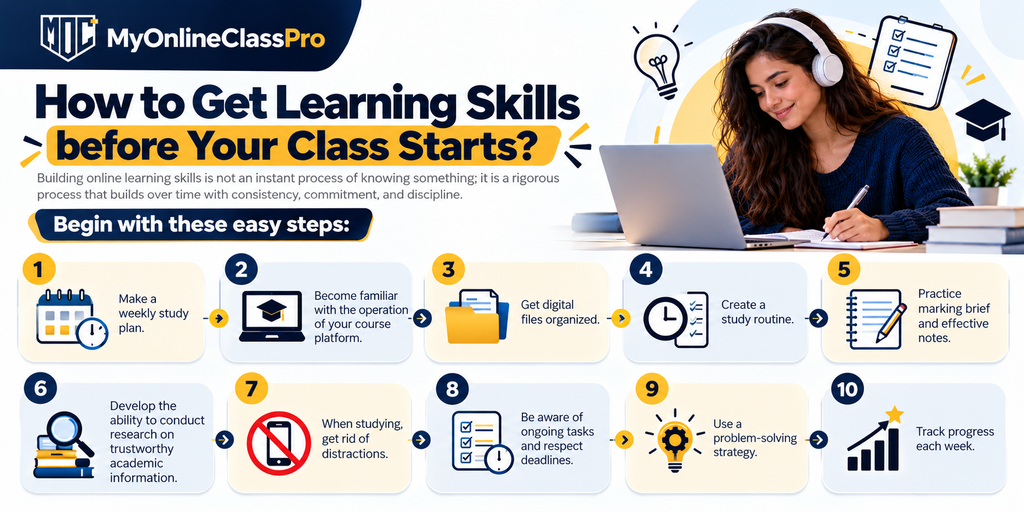
Building online learning skills is not an instant process of knowing something; it is a rigorous process that builds over time with consistency, commitment, and discipline.
Begin with these easy steps:
- Make a weekly study plan.
- Become familiar with the operation of your course platform.
- Get digital files organized.
- Create a study routine.
- Practice marking brief and effective notes.
- Develop the ability to conduct research on trustworthy academic information.
- When studying, get rid of distractions.
- Be aware of ongoing tasks and respect deadlines.
- Use a problem-solving strategy.
- Track progress each week.
These routines can become your learning habits after a couple of weeks.
Final Thoughts
Academic success doesn’t come with regular classes or participation in every single activity. You need to be highly consistent, motivated, and free from distraction if you want to achieve your academic goal.
There are thousands of students who regularly attend online classes and never miss any. Still, they’re unable to crack their online exams. The reason behind this is an unorganized way of learning. To get success in online courses, make sure you have effective learning skills to survive in the process. You also need to understand that putting effort into your learning process will work only if you are able to strategise your learning and manage your time. Effective learning starts at a point when you realise that planning, strategy, and execution are key for a successful academic career.
FAQs
What do you see as the most valuable skill for online learning?
Important skills include time management and self-discipline, as students need to plan and stay organized to complete online courses.
Are advanced computer skills necessary to take an online course?
No, you will need some simple digital skills, including using a browser, working with documents, accessing online platforms, and digital communication. As you study further up the course, you can acquire more advanced skills.
What are some tips for improving my online learning skills?
First, establish a regular study schedule, plan out deadlines, eliminate distractions, schedule and sort through digital materials, and keep track of your learning process.